
At some point, a successful business outgrows its brand.
The company evolves. Capabilities expand. Strategy sharpens. Teams mature, and the organization becomes more complex. Often, the branding and logo stay the same because they once worked well.
Over time, a gap starts to appear. Materials begin to feel dated next to competitors. Messaging sounds slightly out of step, as if it reflects an earlier chapter of the company’s story. The brand no longer fully represents how the business operates today, how it competes, or how it wants to be understood in the market.
This gap shows up before anyone speaks to sales or engineering. It shapes expectations early and quietly.
That’s usually when the conversation begins. It rarely starts with certainty. More often, it starts as a set of questions. Do we really need to change anything? Is this just a marketing issue? Will customers even notice?
How the problem shows up
As the gap widens, teams adapt to it.
Sales adds context that the brand should already provide. Marketing creates one-off solutions to meet immediate needs. Different groups describe the company in different ways, depending on their role or location. Over time, inconsistency becomes normal rather than intentional.
None of this means the brand failed. It means the business moved forward and the brand hasn’t kept pace.
Why this happens as companies grow
Brand misalignment usually follows positive change inside the company.
Mergers and acquisitions introduce multiple brands and systems without a clear structure. Expansion into more competitive markets places the brand alongside stronger peers and makes weaknesses more visible. Strategy evolves, capabilities expand, and leadership expectations shift, while the brand continues to communicate an earlier version of the company.
In industrial and manufacturing environments, this kind of drift is common. Change happens gradually, and branding is rarely the first thing addressed.
How established manufacturers handle this
Long-standing manufacturers update their brands more often than most people realize. They don’t treat branding as a one-time decision. They treat it as something that evolves alongside the business.
John Deere is a clear example. Over its history, the company has refined its branding and logo many times as products, technology, and markets changed. The core symbol remained recognizable, while execution improved. Brand equity was preserved while relevance increased.
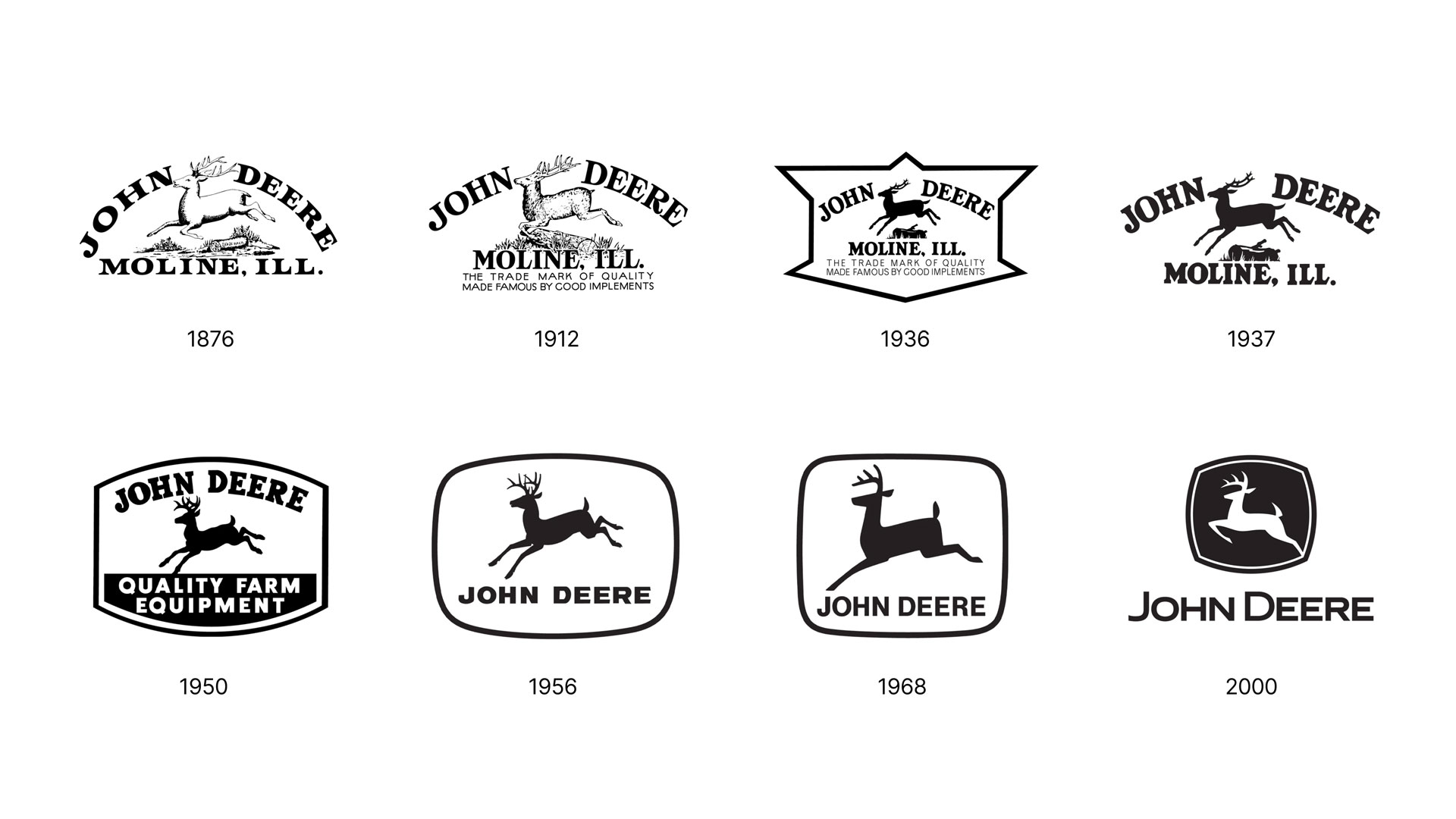
This approach is typical in industrial markets. Brands evolve in controlled, incremental steps. Recognition stays intact, while the system surrounding the logo becomes clearer, more flexible, and more effective.
The goal isn’t reinvention. It’s alignment.
What a brand update actually does
A brand update changes how the business shows up before a conversation ever starts.
In practical terms, it reduces the amount of explanation required in sales conversations. Prospects come in with a clearer understanding of what the company does and where it fits, so less time is spent correcting assumptions or filling in gaps.
It brings consistency across materials that are often created in isolation. Sales decks, proposals, technical documentation, trade show assets, and distributor tools start to tell the same story instead of variations of it. That consistency makes the company easier to understand and easier to represent.
Internally, it gives teams shared language. Marketing, sales, engineering, and leadership describe the company in the same way, which reduces friction and back-and-forth. Decisions about messaging, content, and presentation move faster because there is a clear reference point.
A clear brand system also makes execution easier. New materials take less time to create. External partners have fewer questions. Updates feel incremental instead of custom each time.
Visually, the company presents itself in a way that reflects its current capabilities and scale. The work looks intentional and current, which matters when buyers are comparing similar suppliers.
A brand update does not change how the business operates. It improves how that work is understood and how efficiently it is communicated.
How to approach it in practice
Brand updates that hold up over time follow a clear, structured process.
Discovery gathers stakeholder input, reviews existing materials, and establishes how the brand is currently perceived.
Definition clarifies positioning, tone, and usage so teams have shared guidance.
Design translates that guidance into a visual system built for real-world use and tested against actual applications.
Implementation applies the updated branding consistently, starting with the touchpoints that matter most.
This approach allows change to happen in sequence rather than all at once, without disrupting day-to-day operations.
If your brand no longer reflects how your business operates today, it’s something you can address deliberately and on your terms.
If you’re considering a brand refresh and want a business-focused approach led by an experienced team, we can help. We work with manufacturers and industrial companies to evaluate their current brand, define what needs to change, and implement updates designed to last.