
The next move after AEO/GEO isn't more external optimization — it's turning your structured data inward and making your site its own answer engine.
If you've taken AEO and GEO seriously over the past year, you've done the work: Organization schema, clean JSON-LD across your templates, an llms.txt file, entity-rich headlines, content structured so ChatGPT, Perplexity, and Google's AI Overviews can find you, understand you, and cite you.
Here's the uncomfortable result of that success: a stranger's AI now answers questions about your organization better than your own website does.
Ask Perplexity what your company does and you get a grounded, sourced, conversational answer. Ask your own site's search bar the same question and you get a keyword-matched list of links, ranked by an algorithm designed two decades ago. The visitor with the highest intent — the one who came directly to you and typed a full question — gets the worst experience on the internet's answer to it.
That's the gap. And closing it is the logical next step in the AEO playbook.
Most teams treat structured data as an external signal — something you publish so search engines and answer engines can parse you. But everything you built for AEO is equally valuable pointed inward:
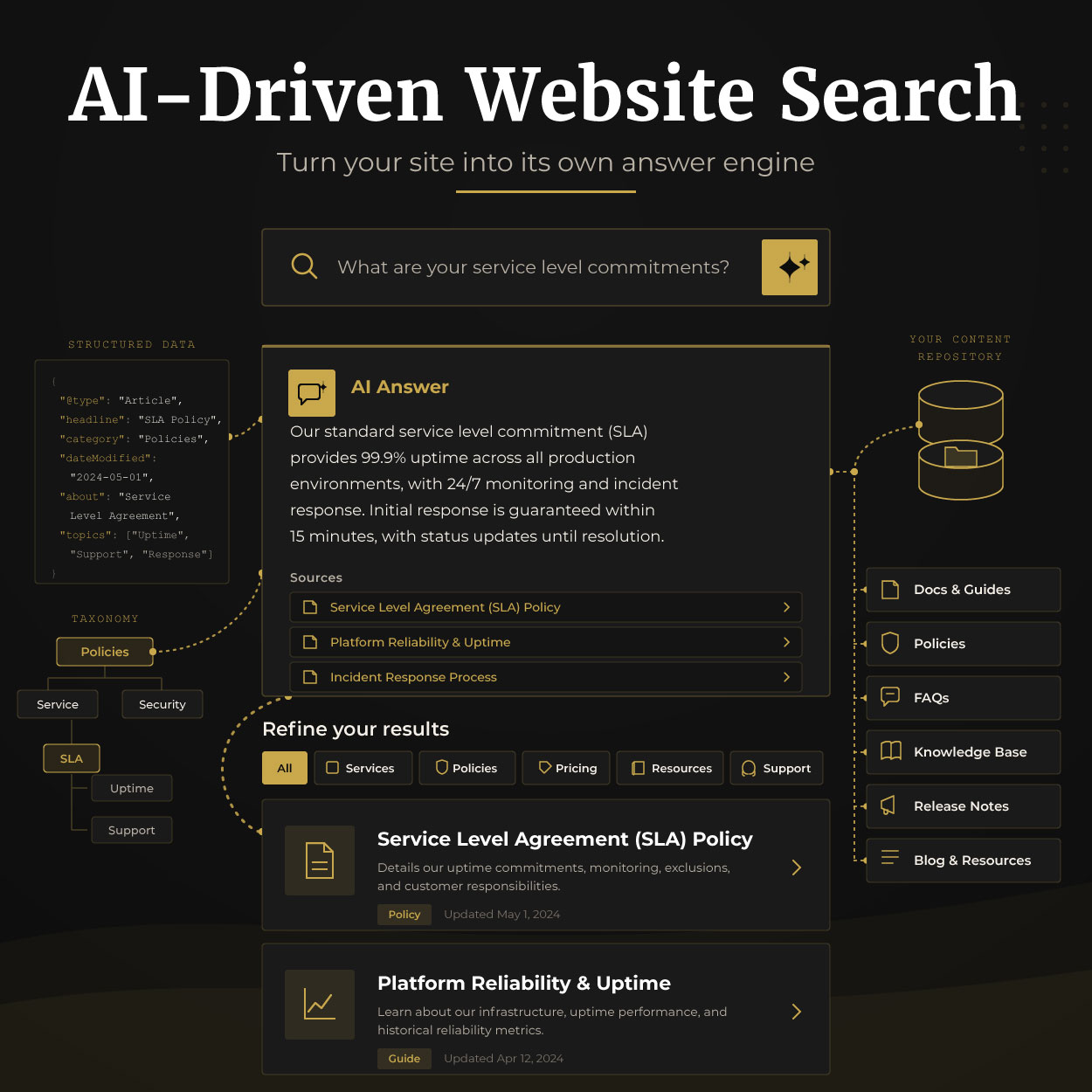
Your JSON-LD is grounding data. The same schema that tells Google's AI what a page is about can tell your search layer what a page is about — content type, topic, author, publish date, category. That's exactly the metadata a retrieval system needs to ground generated answers in the right sources.
Your taxonomy is your facet system. The tags and entity relationships you cleaned up for AEO become filters and ranking attributes. No new information architecture required — you already did it.
Your entity-clean content is retrievable content. Pages written to answer one question well — the core AEO discipline — are precisely the pages a semantic retrieval system surfaces accurately. Content optimized for external answer engines is pre-optimized for an internal one.
In other words: AEO wasn't just an external visibility project. It was, whether you intended it or not, the data-preparation phase for AI-powered internal search.
A generative answer panel above the results. A visitor asks a real question in plain language and gets a concise, sourced summary — built only from your content, with links to the pages behind it. Not the open web. Not a model's training data. Your pages, cited.
Semantic retrieval underneath. The system understands that "how do I get a custom quote" and "RFQ process" are the same question, even when the exact words never co-occur on a page. Keyword search can't do that. Meaning-based retrieval can.
Your existing navigation, intact. Faceted filters built from your taxonomy, sortable results, content previews. AI augments the search experience; it doesn't bulldoze the patterns your visitors already know.
Platforms like Google Vertex AI Site Search have made this buildable on top of an existing CMS — no replatforming, no rip-and-replace of your current index. You point it at your content, map your structured data to search attributes, and tune.
Visitor expectations have already shifted. People trained by AI search don't browse — they ask. The search bar is where your highest-intent traffic concentrates: the prospect ready to buy, the member looking for a resource, the journalist chasing a statistic. Every one of those sessions that ends in a page of mismatched links is intent you earned and then dropped.
There's a second-order effect too. The query logs from a semantic search system are a direct readout of what your audience actually wants to know, in their own words — which feeds straight back into your AEO content strategy. The loop closes: structured data powers better internal answers, internal questions reveal the next content to structure.
This is a weeks-scale project, not a quarters-scale one. We recently scoped a full implementation — architecture, index configuration, structured data mapping, generative answer layer, custom interface, relevance tuning — at 6–8 weeks, with ongoing infrastructure costs of roughly $200/month. Before committing, we stood up a working test against the organization's live content and ran real visitor queries through it; natural-language questions that returned noise under the legacy keyword index came back with the right pages and a grounded summary on top. The test, not the pitch, is what moved the project forward.
That's the right sequence for any organization considering this: prove it on your own content first. If your structured data is in good shape, the test takes days.
AEO made you legible to other people's answer engines. Hybrid search makes you one.
If you've done the schema work, the expensive part is behind you — what's left is connecting it to a retrieval layer and putting an answer where your search results used to be.
Book a Free Search Audit → We'll run your real visitor queries through a hybrid search test against your own content and show you the before and after.