
Most manufacturers lose winnable deals not to a cheaper competitor, but to the gaps between the systems that carry a buyer from first click to signed quote. A prospect submits an RFQ on the website. It lands in an inbox instead of the CRM. Sales rekeys it by hand. The configuration waits on engineering. The quote comes back four days later — after a competitor already answered. That deal wasn't lost on price. It was lost in the space between systems that were never built to talk to each other.
That space doesn't show up on a P&L. There's no line item for revenue lost to slow handoffs, so it goes unmeasured — and unmeasured problems don't get fixed. Meanwhile the buyer, who compared two suppliers on responsiveness as much as on spec, has already moved on.
The path from inquiry to close crosses three or four systems bought at different times for different reasons. Each one works. The seams between them don't. Quotes stall at four predictable points:
Every one of these is a handoff. Fixing the systems in isolation does nothing about the seams — which is also why turning a brochure site into a revenue engine is less about any single tool than about how the tools connect.
The delay lives in the seams, not the systems.
Integration is not ripping out systems that work and standardizing everything on one vendor's platform. That's the pitch of a firm that sells the platform — expensive, disruptive, and it asks you to stop running your business while the plumbing gets replaced.
Integration means the systems you already run hand off cleanly, in the right sequence, without a human retyping data at every step. The CRM you chose, the ERP that runs the floor, the configurator your estimators trust — connected, not replaced. An inquiry that flows from website to CRM to quote to ERP untouched, and a single view of the customer every part of the business can see.
Your systems were chosen for good operational reasons. The problem was never that you picked the wrong CRM. It's that nothing was built to carry a deal across the seams between the tools you already own. And the work has to respect operations: close the highest-leverage seam first, prove it moves the number, then move to the next. Modernization that disrupts operations isn't modernization.
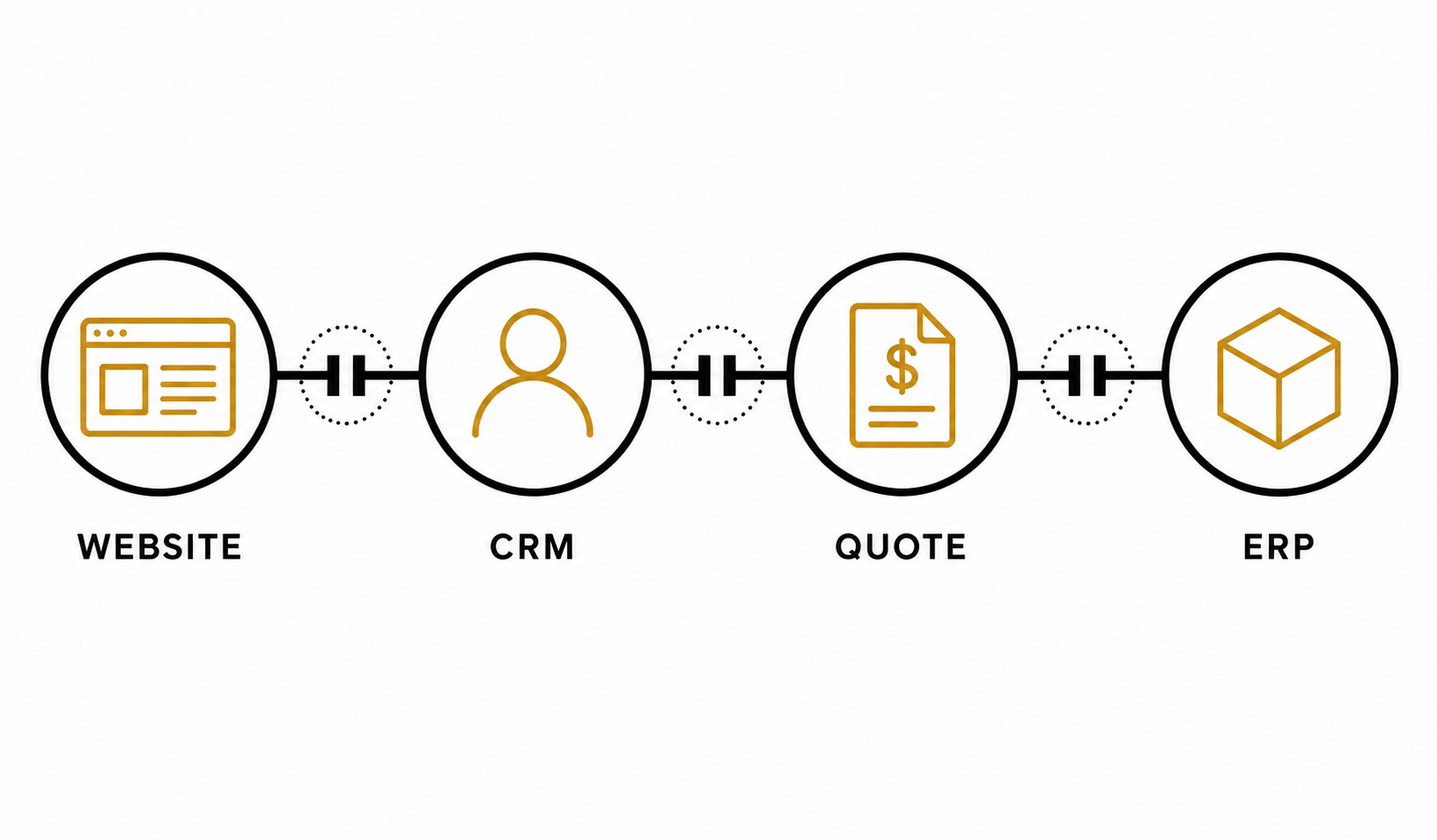
Before you evaluate a single tool, trace one recent deal end to end. Where did the RFQ land, and how long before someone could act on it? Where did it wait on a person or a spreadsheet? How many times was the same information retyped? The slow step is almost never the one everyone complains about — it's the handoff nobody owns. The same discipline applies well before the quote, too: buyers do most of their research on your product catalog long before they ever submit an RFQ.
We built a one-page Quote-to-Close Leak Map — a self-diagnostic that walks the four seams and shows you where to measure. Trace one deal through your own systems and you'll see the gap that isn't on any P&L.
Download the Leak Map →Quotes stall at four handoffs between systems: intake, when an RFQ lands in an inbox instead of the CRM; configuration, when the spec waits on one estimator or spreadsheet; quote generation, when pricing, terms, and specs are reassembled by hand; and follow-up, when no unified view of the customer exists to show where a quote sits. The delay lives in the seams between systems, not inside any one of them.
Integration means the systems you already run — website, CRM, ERP, and configurator — hand off to each other cleanly and in the right sequence, without a person retyping data at every step. It does not mean replacing working systems with a single vendor's platform. The goal is an inquiry that flows from website to CRM to quote to ERP untouched, plus a single view of the customer every part of the business can see.
No. In most cases the systems were chosen for good operational reasons and work fine on their own. The problem is that nothing was built to carry a deal across the seams between them. Fixing it is a technology-agnostic effort: connect the tools you already own, close the highest-leverage seam first, prove it moves the number, then move to the next — without halting operations.
Trace one recent deal end to end. Note where the RFQ landed and how long before someone could act, where it waited on a person or spreadsheet, and how many times the same information was retyped. The slow step is almost never the one everyone complains about — it's the handoff nobody owns. A one-page quote-to-close diagnostic makes the measurement repeatable.
Manufacturers don't close deals online. Buyers run months of self-directed research first....
Manufacturers don't close deals online. Buyers run months of self-directed research first....
Manufacturing CRM integrations that move revenue...


