
That's the question B2B leaders are asking right now, usually after watching a competitor get named in an AI answer they weren't part of. The honest answer is less exotic than the AEO industry wants it to be: AI engines cite brands they can clearly identify, verify, and trust. If your site doesn't tell machines who you are in a language they parse, you don't exist in their answers — no matter how good your content is.
We recently put that to the test with a multi-region B2B client. Here's what happened.
When we ran the baseline audit, the picture was familiar. Strong company, real expertise, solid traditional rankings — and an AI Visibility score of 41 out of 100. Roughly 1,000 monthly mentions across AI engines. Google's AI Overviews barely acknowledged they existed, scoring a 20.
The diagnosis wasn't a content problem. It was an identity problem. The site's structured data was incomplete and partially broken: thin Organization schema, JSON-LD errors that silently invalidated markup, no machine-readable entity definition, headlines that described offerings without ever defining the company itself. Humans could figure out who they were. Machines couldn't.
No secret tactics. No "prompt injection for SEO." The work was structured data and technical hygiene, executed completely:
Entity-first schema. We rebuilt the Organization schema from the ground up — legal identity, locations, services, relationships between entities — so every AI crawler gets an unambiguous answer to "who is this and what do they do."
JSON-LD repair. Broken markup is worse than no markup; it signals carelessness to validators and gets discarded. We fixed every error and validated the full set.
Entity-rich copy where it counts. H1s and key page intros were rewritten to define the company and its category explicitly, not just pitch the offering. AI engines extract definitions; they don't infer them.
Machine-readability signals. Including an llms.txt file and the unglamorous technical SEO fixes — crawlability, canonical hygiene, page structure — that determine whether engines can confidently use a page at all.
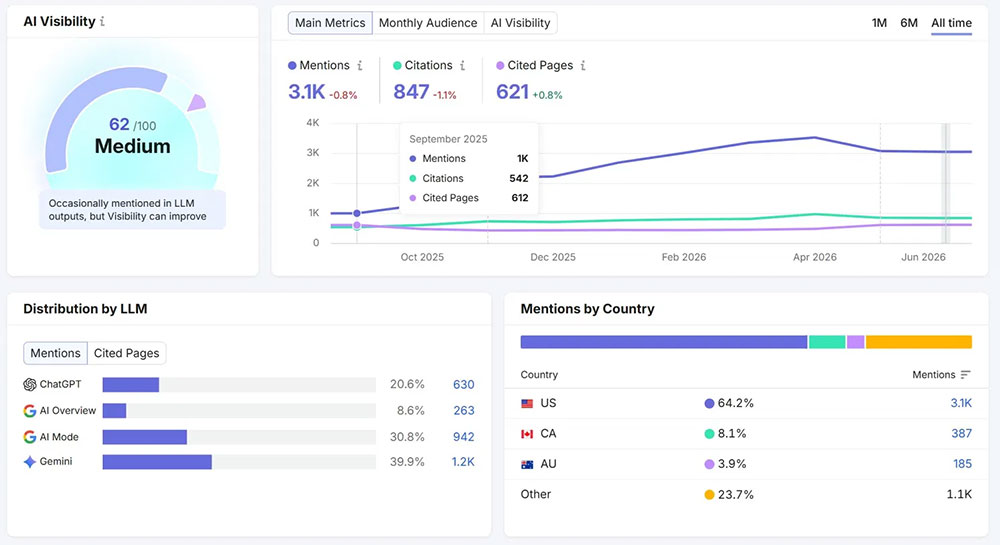
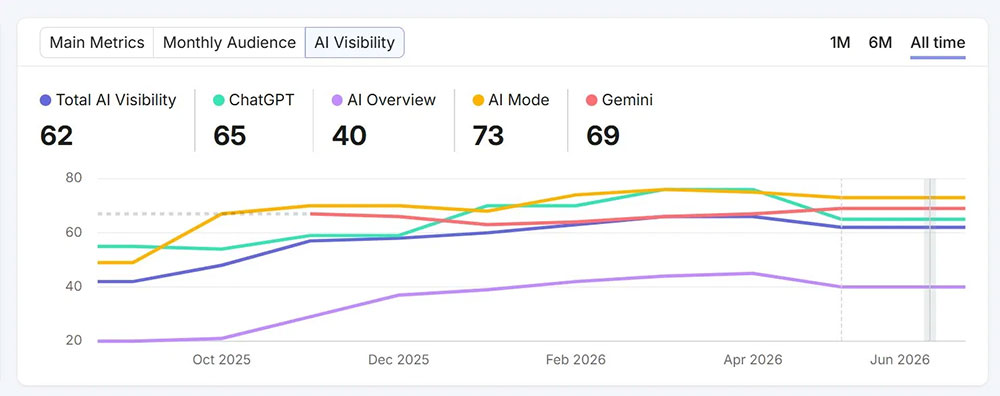
Here's the part of the data that should change how you think about this: ChatGPT accounted for only 21% of the brand's AI mentions. Gemini drove 40%. Google's AI Mode drove another 31%.
That means over 70% of this brand's AI visibility lives on Google's AI surfaces and Gemini — the engines wired directly into the search behavior of B2B buyers. Teams that treat "AI optimization" as a ChatGPT project are optimizing for a fifth of the opportunity.
The good news is that the same foundation serves all of them. Clean schema, defined entities, and technically sound pages aren't engine-specific tricks. They're the substrate every AI system draws from. Build it once, get cited everywhere.
If you're being told GEO requires reinventing your content strategy, be skeptical. In our experience, most B2B sites fail in AI answers for the same three reasons: the engines can't confidently identify the entity, the structured data is broken or thin, and the pages never state plainly what the company is.
Those are fixable problems with measurable outcomes — and the window matters. AI engines are forming durable associations about which brands belong in which answers right now. The brands that establish entity clarity early become the default citations; everyone else fights to displace them later.
We start every engagement the same way: a baseline AI visibility audit, a schema and technical review, and a prioritized fix list — so you know exactly where you stand before anything gets built.
Turn your structured data inward and make your site its own answer engine...
Modern discoverability requires combining SEO, AEO, GEO, and SGO to ensure content remains visible across search engines, ...

